


Have you noticed just how much time we spend at this place called work?
Whether you see it as The Daily Grind, The Means to Put Food on the Table or Doing What I Love, the truth is, that for many of us we spend more time at work than with our family.
Meaning that how we feel about our work and our working environment plays a significant role in determining our overall health and well-being.
The need for better workplace wellbeing is a given. The economic argument that healthy employees drives economic participation, productivity and resilience is sound.
And that recognition is being realised by the increasing number of organisations and businesses signing up for workplace well-being programs, the market value of which was estimated at AUD$2.27bn in 2025 and forecast to grow to AUD$7.54bn by 2034.
As a strategic business investment.
But the proverbial fly in the ointment is that the health outcomes for all this investment don’t stack up, despite employees often enjoying participating in these programs and cite feeling better for having taken part.
A study of 33,000 employees by Song and Baiker and published in JAMA, found little to no impact on self-reported measures, medical cost saving or general health improvement.
Another UK based study carried out by William Fleming and his team, published in 2024, compared the health outcomes of those who participated in mindfulness training, resilience workshops and health app wearables to those who didn’t, and found no difference between the two groups.
Does this mean we’re wasting time and money and that workplace well-being programs should be scrapped?
This was the premise of my keynote presentation delivered recently at the Australian Institute of Management WA Workplace Well-being Conference.
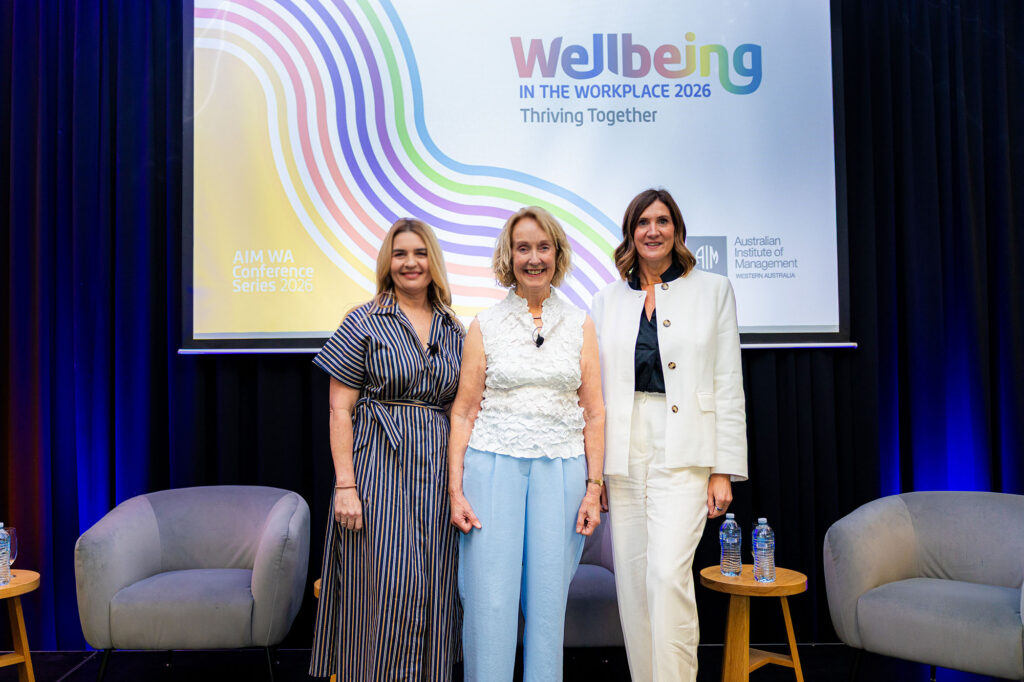
Sandra Holloway AIM WA CCO, Dr Jenny Brockis, and Alex Quinn AIM WA Head of Events
I am all for better heath and well-being in every environment, including the workplace, but when the expected benefits don’t show up, questions need to be asked.
What are we trying to achieve here?
What do we understand as the meaning of “well-being”?
Have we asked the people the programs are targeting, what they think would make the biggest difference?
It’s all well and good to have the best of intentions.
But good intentions alone are not enough.
It’s very easy to get sucked into paying for a fabulous sounding program.
But is this all glitz and good marketing?
What is it based on, and is it relevant to your particular business and your employees?
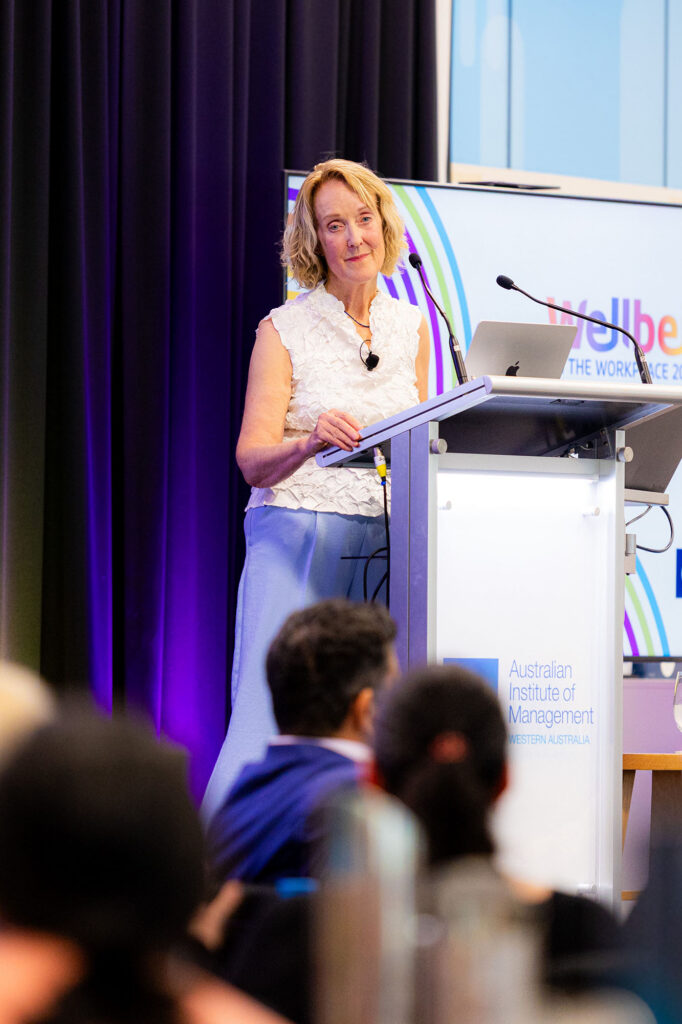
Keynote presentation at the Australian Institute of Management WA Wellbeing in the Workplace 2026 conference
What the studies are saying is this.
Well-being cannot be prescribed as a program; it has to be part of the cultural norm.
Encouraging healthy behaviours – think fitness challenges, health awareness weeks, discounted gym memberships are great for those already motivated to join in.
But what of those who aren’t?
No matter how tasty the cupcakes, a policy or action will only be believed and agreed to when it is instilled into the very essence of what the leaders and executives stand for, and demonstrate through their own behaviours.
It’s all about the environment and good job design.
This is where a humanistic approach that’s evidence based can work.
We desperately need to lower the prevalence of burnout, loneliness, mental illness and psychological distress that’s emanating from the workplace.
In Lifestyle Medicine, practitioners focus on asking the question,
“What keeps you well?”
“What would make the biggest difference to help you handle all the stress, frustration and exhaustion you’re experiencing ?”
“What matters to you?”
Because prevention is the most powerful way to sustain health.
We know too, that good health is created beyond the walls of work. It’s vital we tackle the wider social determinants of health including job security, social connection and equitable support.
Auditing your workplace wellbeing program, through the lens of the lifestyle medicine framework can show up any gaps in
- The energy needed to deliver great work.
This is stress management in action and can be achieved through the two-pronged approach of self-care along with a systemic approach that addresses poor job design, lack of autonomy and low-quality managerial input.
- The clarity required to diminish cognitive overload.
Here an audit can determine what a realistic workload is, to support delivering enough, and no more.
It’s about avoiding overuse of the prefrontal cortex to deliver results by enabling use of the default network, to balance focus with recovery, effort with reflection and busyness with depth.
This is what creates insight, creativity and adaptability, and is readily achieved by encouraging more movement across the workday, along with stepping outside into green space to broaden perspective, and to restore attention along with healthy eating (for better cognitive function) and good quality restorative sleep, the most undervalued well-being tool on the planet.
- Creating Connection.
One of the strongest messages to come out from the 2026 Report on the State of Burnout in the Workplace in Australia wasn’t the fact that the current rate of 36% is essentially unchanged from previous years, rather that it’s the level of excess work hours contributed regularly by an individual.
Doing a few extra hours when needed and that you enjoy isn’t a problem.
It’s the excess hours performed as an attempt to keep on top of the workload that does the damage, because it takes the individual away from the team. Those extra hours are performed in isolation, away from others and also reduces the opportunity for quality down time with family and friends.
We are living in an epidemic of loneliness which is damaging physical, mental and emotional well-being and contributing to the development of chronic disease, mental illness and shorter lives.Best health practices address the root causes of illness and disease.
This is just as true for the workplace environment.
If your workplace wellbeing program looks like action is happening, but it’s really only well-being theatre, treating symptoms as the cause of individual failure, it’s time to stop and ask, “how can we better design the workplace?”
Rather than adding in more stuff, ask what can be removed
- to enable a proper vacation to be taken without the risk of returning to an overflowing inbox,
- to facilitate better thinking through short mental breaks across the day,
- to restore energy by alleviating some of the stress associated with go-go-go cultures of some workplaces that fail to enable employees to function within human capacity.
Workplace well-being is important.
But it needs to be done better by tackling the real issues of poor job design, lack of autonomy and poor management.
So, next time you find yourself wondering whether you should be investing into a bigger and better well-being program, check in first to ensure you’re addressing what really counts. Spoiler alert, it’s the work.
Is workplace well-being being delivered well in your workplace?
I’d love to hear your thoughts.
If you’re a health practitioner, and health and well-being in all environments matter to you, we’d love you to join us at the 2026 Lifestyle as Medicine Conference being held in beautiful Hobart November 13th to 15th.
The theme is The Nature of Health, and I’ll be presenting on why nature isn’t optional, it’s life support.
Tickets are still available.

